
5.0★ Google · 5.0★ Oneflare · VEU Accredited Supplier A003039 · REC 35448 (Energy Safe Victoria) · ARC AU50700 (refrigerant handling) · Cheltenham VIC
Most people reach this question with a plumber in the laundry and a like-for-like gas quote in hand. If that’s you, the answer you need is in the next 60 seconds. The working sits underneath it.
Every number here names its source. None of the pages we checked in the Melbourne results for heat pump vs gas hot water cite a single one.
Call 1300 201 358 · Get a Free Quote No obligation. We’ll tell you if gas is still the right call for your place.
Your gas hot water just died, the 60-second answer
The short version: for most Melbourne South East homes it’s now the heat pump. There are a handful of situations where gas still makes sense and they’re listed further down, so check those before you decide. What’s actually true today:
- You are not required to replace like-for-like. A dead gas unit can be swapped for a heat pump, usually inside the same week.
- You are also not banned from gas today. Replacing a failed gas system with another gas unit is still legal in Victoria right now.
- But what you buy this week is a 10–15 year asset. The Victorian Government has announced that from 1 March 2027, an end-of-life gas hot water system in an existing home must be replaced with an electric one. Buy gas now and, when it fails after that date, the replacement will generally have to be electric unless an exemption applies.
- Sort the rebate before you sign, but a dead system isn’t automatically a lost rebate. The normal process confirms eligibility before installation. Solar Victoria also has an emergency pathway, and the VEU allows limited retrospective claims. Both carry conditions that are easy to lose in a rush, so ask before you commit to the job.
- The efficiency gap is real; the bill gap is smaller than most sites claim, because of a gas charge almost nobody subtracts.
Call 1300 201 358, we’ll check rebate eligibility on the phone before you commit to anything.
Heat pump vs gas hot water running costs in Melbourne South East
Most comparison pages use a round 30c/kWh and 3.5c/MJ. Neither is a Victorian number in 2026, and the gas rate sits below every current Victorian standing offer, which quietly flatters gas.
| Gas storage | Heat pump | |
|---|---|---|
| Energy in, per year | ~22,900 MJ | ~1,190 kWh |
| Rate applied | 4 – 6c/MJ first block, falling to 2.5 – 4c/MJ | 27.4c/kWh |
| Annual energy cost | $915 – $1,375 | ~$327 |
| Gas daily supply charge | ~$330/yr regardless of usage | $0 |
| Same, with rooftop solar | n/a | ~$100 |
Assumptions and sources: 200 L/day for a four-person household heated 15°C to 60°C (13.75 GJ thermal/yr); gas storage at 60% seasonal efficiency; heat pump at an annual average COP of 3.2. Gas rates are the spread across published Victorian residential retailer offers, because there is no regulated gas equivalent of the electricity default offer, so check yours on Victorian Energy Compare. The electricity rate and bill come from the Essential Services Commission’s Victorian Default Offer 2026-27 determination: our Bayside and south-east service area sits in the United Energy zone, where the flat domestic rate is 27.35c/kWh and the reference annual bill is $1,529 at 4,000 kWh. Solar figure assumes 70% self-consumption.
Gas is billed in declining blocks, and hot water sits in the worst one. The first slice of usage costs roughly 4 to 6c/MJ before dropping toward 2.5 to 4c/MJ. For a household using gas only for hot water, much of that consumption can stay in the higher-priced first block, depending on the retailer’s tariff structure and where its thresholds sit, which is why the range above uses the first-block rate.
The direction of travel reversed this year. Victorian residential gas standing offer tariffs rose 5.9% on 1 July 2026. That same month the Victorian Default Offer for electricity fell about 5%, worth roughly $84 a year to the average household. Most Victorians sit on market offers rather than standing offers, and there is no default offer for gas at all, so treat the gas rise as the clearest published signal rather than a universal one.
Distrust any single “gas costs $X a year” figure, including ours. Published estimates for gas hot water range from $395 to $1,200 a year because they assume different households, tanks and tariffs. Ours sits at the top of that spread, and slightly above it, because we assume four people and 200 L/day. The range is the honest answer, the caption above exists so you can check ours against your own bill.
The gas connection charge nobody subtracts
Here is the trap in every heat pump vs gas hot water cost comparison online.
Replace the hot water but keep a gas cooktop or heater and you still have a gas connection, and still pay the supply charge, roughly $330 a year on a typical market offer and as much as $490 on a standing offer, whether you burn a megajoule or not. You remove most of your gas usage and none of your gas connection cost. Much of the modelled saving evaporates.
The full saving needs the connection gone. That is a one-off cost worth knowing before you plan:
| Action | Cost | Distributor |
|---|---|---|
| Permanent abolishment (connection removed) | $270.39 | AusNet |
| Permanent abolishment | $268.40 | Multinet |
| Temporary disconnection (meter capped) | $70 – $98 | Varies by distributor |
Source: AusNet’s 2026-27 published tariff schedule ($270.39 incl. GST) and the Multinet residential abolishment fee as passed through by retailers ($268.40), effective 1 July 2026. Abolishment is permanent; disconnection is not, and the supply charge may continue.
So the real question isn’t “heat pump or gas hot water”, it’s when the cooktop and heater go too, because that’s when the supply charge actually stops. Sequencing all three around their own end-of-life dates beats replacing them one panicked appliance at a time. Our home electrification page covers that sequence; our Victoria gas ban guide has the full regulatory detail.
Want a real number for your house? Get a free quote or call 1300 201 358.
What it costs to replace gas hot water with a heat pump in Victoria
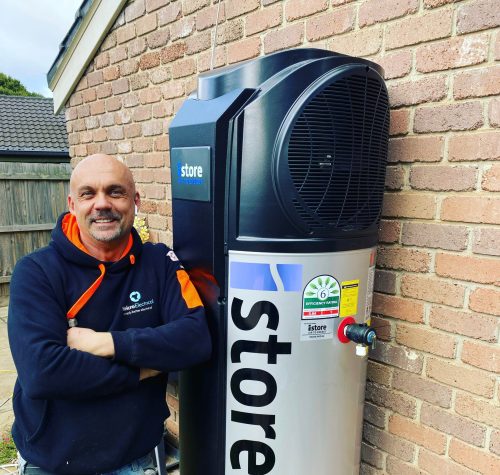
The iStore 270L is listed in our shop at $2,950 before rebates. Installation is quoted separately, because it depends on switchboard capacity, clearances and the cable run, all of which we check before quoting rather than discover on install day. We also install Sanden and Haier.
A like-for-like gas replacement typically lands between $1,500 and $2,800 installed in this market according to published Melbourne cost guides, with valve, pipework or regulator work adding $150 to $600. That range does include installation, so compare the two with the difference in mind.
“Helcro Electrical has truly impressed me with their expertise and precision during the installation of my induction cooktop and iStore hot water heat pump. The team’s professionalism and attention to detail make them my top choice for any electrical upgrades — a highly recommended service for a seamless and efficient experience.”
— Ko Le, ★★★★★ Google review
Gas is cheaper on the day and heat pumps are cheaper every day after, which is why the rebates decide it.
How the rebates actually stack
The order of operations changes the total, and this is where aggregator sites go wrong.
- Federal STCs come off the purchase price first.
- The VEU discount comes off next, and the amount depends on what you’re replacing: $560 for a gas hot water system, $630 for an inefficient electric one. As a VEU Accredited Supplier (A003039) we generate the certificates and apply that discount to your invoice on the day. You never lodge anything.
- The Solar Victoria hot water rebate is 50% of the purchase price remaining after STCs and VEECs, capped at $1,000, or $1,400 for a system with at least 50% Australian-made content.
That third step is why “up to $3,200” totals elsewhere overstate reality: Solar Victoria rebates half of what’s left, not half the sticker price.
And here is why our total is lower than the one you’ll see quoted everywhere. The widely-published combined figure is up to $1,630, or $2,030 locally-made. That uses the $630 VEU amount, which is the rate for replacing an inefficient electric system. If you’re coming off gas, which is what this page is about, the VEU amount is $560, so the published program maximum is up to $1,560, or $1,960 for an eligible locally made product. We use the gas number throughout because that’s the reader we’re writing for.
Treat both of those as ceilings, not expectations. Because Solar Victoria pays half of what’s left after STCs and VEECs, its share only reaches the $1,000 cap if less than $390 of STCs comes off first. On a $2,950 system with STCs in the usual $500–$700 band, Solar Victoria’s share lands nearer $845 to $945. The worked example in the ten-year table below is the honest version, and it is better than the ceiling, not worse.
The $400 locally-made uplift has applied since 1 July 2025. “Locally made” is a listing status, not a brand claim. Solar Victoria assesses specific models against its local content criteria and publishes the approved ones on a separate product list; being sold by an Australian company does not qualify a system, and neither does an “Australian made” line in a retailer’s product title. Wilson’s WHPS-160A, WHPS-250A and WHPS-315A were added to that list in July 2025, to give a sense of how model-specific it is. Ask to see the listing before anyone quotes you $1,400.
We don’t apply the $1,400 tier to the iStore 270L. At $2,950 it would make no difference in any case: the uplift only changes your total where 50% of the remaining price would otherwise exceed $1,000, and here half the remainder is below even the lower cap.
Who qualifies
| Criterion | Rule | Applies to |
|---|---|---|
| Household taxable income | $150,000 or less | Solar Victoria only |
| Property value | Under $3 million | Solar Victoria only |
| Existing system age | 3 years old or more | Solar Victoria (one per address) |
| Existing system age | 2 years old or more | VEU (up to 2 per household) |
| Minimum customer contribution | $200 | VEU |
Source: Solar Victoria and the Victorian Energy Upgrades program. The income cap tightened from $210,000 to $150,000 effective 1 July 2026, pages still quoting $210,000 are out of date. There is no income test on VEU or federal STCs.
Two local notes. The $3 million property cap bites harder in Bayside than almost anywhere in Victoria. And the two system-age rules are different numbers for different programs, three years for Solar Victoria, two for VEU, which we see blended constantly.
Full detail on how the VEU discount works is on our Victorian Energy Upgrades page.
If yours has already failed
Confirming eligibility before anything is installed is the normal process and still the safest route. But the most common reader of this page has a dead system and a plumber standing in the laundry, so the exceptions matter more here than they would anywhere else.
Solar Victoria has an emergency pathway. If your system has broken down or is unsafe, you do not have to wait for Solar Victoria to confirm eligibility before installing a replacement. Two conditions still bind, and both are easy to lose in a rush: the work has to be done by an authorised retailer, and the product has to be an eligible one. Let an emergency plumber fit whatever is on the van and the rebate is gone no matter how eligible you were. You then need to prove eligibility as soon as possible after installation.
The VEU allows limited retrospective claims. These run through an accredited provider, and there is a hard deadline: the claim must be processed within six months after the end of the calendar year the work took place in. Work done in 2026 has to be lodged by 30 June 2027. Providers are not obliged to take retrospective work and frequently won’t, so treat it as a fallback rather than a plan.
The short version: calling before the unit goes in costs nothing and protects both. Calling after sometimes still works.
Ten-year cost of ownership
Rather than subtract a program ceiling, this runs the rebates in the order they’re actually applied, on the iStore 270L at its shop price.
| Gas storage | Heat pump | Heat pump + solar | |
|---|---|---|---|
| Initial cost | $2,150 installed | $2,950 + install | $2,950 + install |
| Less federal STCs | $0 | –$600 | –$600 |
| Less VEU discount (coming off gas) | $0 | –$560 | –$560 |
| Less Solar Victoria, 50% of the $1,790 left | $0 | –$895 | –$895 |
| Net initial cost | $2,150 installed | $895 + install | $895 + install |
| 10 years of energy | $11,450 | $3,270 | $1,000 |
| 10 years of gas supply charge | $3,300 | $0 | $0 |
| One-off gas abolishment | $0 | $270 | $270 |
| Ten-year total | ~$16,900 | ~$4,435 + install | ~$2,165 + install |
Assumptions and sources: the gas figure is the mid-point of the $1,500–$2,800 indicative installed market range above, and is not our own quote data; the heat pump figure is the iStore 270L shop listing price, which the heat pump columns treat as excluding installation, so your real upfront cost is higher by that amount. We publish it this way rather than invent an installed figure. Rebates are worked in program order: federal STCs at the mid-point of the $500–$700 band for this class of system, then the $560 gas-to-heat-pump VEU discount, then Solar Victoria at 50% of the $1,790 remaining. Your STC value moves with the model and the install date, and every dollar of it moves the Solar Victoria figure by 50 cents in the other direction, so treat $895 as the shape of the answer rather than a quote. Gas energy at the $1,145 mid-point of the running-cost range above; supply charge at the market-offer rate rather than the higher standing-offer one; abolishment at the AusNet residential rate.
One scenario note, because these are two different households and the difference is $3,300. The heat pump columns above assume the gas connection is permanently abolished: the supply charge stops, and the one-off abolishment cost is included. If you instead keep gas for cooking or heating, remove the $270 abolishment and add roughly $3,300 in supply charges across the ten years. That second version is the one most people actually land in, and it is why the sequencing section above matters.
That gap is the whole argument, and your version of it depends on your tank, your tariff and your roof. Get a free quote or call 1300 201 358 and we’ll run your numbers instead of the model’s.
How each system works
A gas unit burns gas to make heat, and physics caps it: it can never deliver more energy as hot water than it consumed as gas, and a storage tank loses more again standing idle.
A heat pump doesn’t make heat, it moves it, a refrigeration cycle pulls warmth from outside air into the tank. That’s why it delivers three to four units of heat per unit of electricity, and why its performance tracks the outside temperature.
The honest CO₂ answer for Victoria
National guides routinely claim a heat pump saves 1.5 to 2.2 tonnes of CO₂ a year. Those use a national-average grid. Victoria’s is still substantially brown coal, so the honest Victorian number is smaller.
| Annual CO₂-e | |
|---|---|
| Gas storage (22,900 MJ) | ~1.18 t |
| Heat pump, grid electricity | ~0.88 t |
| Heat pump, 70% solar self-consumption | ~0.26 t |
Sources: Victorian grid emissions factor 0.74 kg CO₂-e/kWh; natural gas Scope 1 factor 51.53 kg CO₂-e/GJ. Both from the National Greenhouse Accounts Factors 2026, published by DCCEEW, which replaces the 2025 factors and applies to the 2026-27 reporting year. Household assumptions as above. This is an operational energy comparison: gas Scope 1 combustion emissions against electricity Scope 2 generation emissions, with the upstream supply chain of each fuel excluded on both sides.
On grid power alone that’s about 0.3 of a tonne a year, not two tonnes. We’d rather tell you that than quote a number you could disprove.
Two things improve it, and both compound. The grid decarbonises every year; a gas appliance never does, every renewable project added to Victoria’s grid improves the heat pump’s number for the rest of the unit’s life, while the gas unit’s emissions are fixed on install day. And rooftop solar cuts the remainder by about two thirds immediately, to roughly 0.26 t at the 70% self-consumption this page assumes throughout.
Do I have to replace my gas hot water system in 2027?
No, and almost every page covering this overstates it.
What the rule does:
- From 1 March 2027, an end-of-life gas hot water system in an existing home must be replaced with an electric one.
- From 1 January 2027, new homes must be all-electric with no new gas connection. Building permits approved before 31 December 2026 may still allow one.
What the rule does not do:
- It is not a forced rip-out. Nobody is coming for a working system.
- Gas systems can still be repaired, before and after the date. If yours can still be repaired, repair it.
- For owner-occupiers, gas cooking and gas space heating are completely unaffected by the hot water rule.
- Homes on LPG sit outside the rule entirely, whether that LPG is bottled or reticulated. The rule reaches reticulated natural gas only. Being outside the rule isn’t the same as holding an exemption, and no application is involved.
- Some apartment and other Class 2 buildings supplied by a centralised hot water system are exempt from the replacement requirement.
The broader reform package is projected to free up just under 12 petajoules of Victorian gas a year by 2029. The Victorian Government’s current published estimate is that a new all-electric home built from 2027 saves around $990 a year, rising to about $1,920 with solar; IEEFA’s independent modelling of full electrification lands near $1,200.
Read those carefully, because they get quoted loosely everywhere. They are whole-of-home figures covering cooking, heating and hot water, and the $990 applies to new builds, not to your existing house. The government’s own figure for the swap this page is actually about, gas hot water to efficient electric in an existing home, is around $400 a year. That sits below our table, and the government doesn’t publish the household assumptions behind it. Ours are in the caption above, which is rather the point.
Full regulatory detail is on our Victoria gas ban page rather than duplicated here.
How old is your gas hot water system?
Gas storage units generally last 8–12 years, heat pumps 10–15. Join that to the 2027 date and the decision stops being abstract.
| System age | What it means | What we’d do |
|---|---|---|
| Under 5 years | Likely to fail after March 2027 anyway | Nothing yet. Plan the budget, revisit at 8 years. |
| 5–8 years | Failure plausible either side of the date | Get a heat pump quote now, while it isn’t urgent. Check rebate eligibility early. |
| 8+ years | Likely to fail before or around the deadline | Switch on your terms, not in an emergency. Eligibility has already tightened once this year. |
| Already failed | You’re choosing today | Heat pump, unless a case below applies. A gas swap buys a 10-year asset that will generally need an electric replacement when it fails. |
The point is the overlap: a gas unit installed today runs well past 1 March 2027. That’s the real urgency, and it has nothing to do with fear.
Get a free quote or call 1300 201 358, tell us your unit’s age and we’ll tell you honestly whether it’s a now job or a watch-and-wait.
When gas still makes sense
Two of these are about what the rule covers. Two are about your house. They are not the same thing, and they get blended constantly.
Outside the rule’s reach:
- You’re on LPG, bottled or reticulated. The rule targets reticulated natural gas only. The economics usually still favour switching, but you’re not on a deadline.
- You’re in an apartment or other Class 2 building on centralised hot water. An exemption applies to some of these, and the decision belongs to the owners corporation either way.
Practical reasons to wait:
- Your system is under warranty and repairable. Repairs remain allowed before and after March 2027. A $400 valve beats a $3,000 replacement.
- There’s genuinely nowhere to put a heat pump. A real constraint, and insufficient space is one of the named exemption grounds, but it has to be assessed rather than assumed.
An exemption pathway exists for homes where electric replacement is genuinely difficult. The Victorian Government has named grounds including insufficient space for an electric system and installation costs that are too high; the detailed criteria sit in the regulations rather than the announcement, and they are what an assessment tests against. If you think you’re in that category, get the site assessed rather than assuming either way.
Siting on a small Bayside block
Heat pumps need airflow and a compressor location. On the narrow side-return blocks common through Cheltenham, Highett and Hampton, the obvious spot is often 900 mm from a neighbour’s bedroom window, a problem better found before installation than after.
This is assessed on site: clearances, condensate drainage, the cable run back to the switchboard, and where the noise actually lands. It’s also why we’d rather quote your house than sell you a box online.
Landlords: the rule is different for rentals
Close to a third of Victorian households rent, and the rental rules are stricter.
In rentals, from 1 March 2027, both gas hot water and gas heaters must go electric at end of life, not hot water alone. Rentals also face an efficient electric cooling requirement in the main living area at the start of a new lease from the same date, and across all rentals by 1 July 2030. A ceiling insulation minimum of R5.0 applies at a new lease to any ceiling space, or part of a ceiling space, where no insulation is currently installed. Existing insulation never has to be upgraded, whatever its rating.
The Victorian Government estimates the hot-water-specific saving for rental households at up to $220 a year, and gas heater to reverse-cycle air conditioning at up to $215. Those are per-appliance figures rather than whole-of-home, which is why we quote them instead of the headline number. “Up to” is the government’s wording, not our hedge.
If you manage a portfolio, schedule these by property instead of reacting to failures. We quote multi-property work.
Do heat pumps work in a Melbourne winter?
Yes, and the honest version is more useful than the reassuring one.
Efficiency is expressed as COP: units of heat delivered per unit of electricity consumed. COP generally falls as ambient temperature drops, and actual performance also depends on water temperature, the specific model and how it’s operated.
For the running-cost model on this page we use an annual-average COP of 3.2 as a modelling assumption, and we’re calling it that rather than dressing it up as a universal performance figure. Your actual figure depends on the system selected and how it runs.
We don’t publish a single headline COP, and you should distrust pages that do. Manufacturers test at different ambient temperatures, so a COP quoted without its test condition is a marketing number, not a specification. We show the manufacturer’s figure with its test standard on your quote.
Two things nobody else on this results page will tell you:
Some models fire an electric booster element on the coldest mornings. While that runs, the unit is operating at a COP of 1, a plain electric element, and still being sold as a heat pump. Ask whether the model you’re quoted uses one, and we’ll tell you straight if it does.
CO₂ refrigerant (R744) units keep working far colder than Melbourne gets. Sanden’s published specification for its Eco Plus units says they operate effectively between –10°C and 43°C without needing an electric backup or booster element, which is the part that matters: no booster means none of the COP-of-1 mornings described above. Bayside doesn’t get near –10°C, so cold-weather performance is a solved problem here; it stays a real question in alpine Victoria.
Noise, and the regulation people get wrong
Heat pumps have a compressor and a fan, so they aren’t silent. Manufacturers publish a sound figure at one metre and the spread between models is wide. Split systems keep the tank indoors and leave only the compressor unit outside, which mostly buys you freedom to site the noisy part away from a boundary rather than a quieter machine. Ask for the dB(A) figure at one metre for the specific model you’re quoted, not a general reassurance.
The applicable Victorian standard is Regulation 114 of the Environment Protection Regulations 2021, covering unreasonable noise from residential premises. It works mainly on prohibited hours rather than decibels, and the groups are defined by what the equipment is doing, not what it is. Hot water systems and heat pumps sit in Group 3, together with central heating and any air conditioner or split system running in heating mode: prohibited before 7am and after 10pm on weekdays, and before 9am and after 10pm on weekends and public holidays. Group 4 is the same hardware used for cooling, and it differs at one end only, 11pm instead of 10pm. The morning times are identical. That function-based split is why online summaries blend the two and quote an 11pm cutoff for a hot water heat pump, which never applies to it, because a hot water system is never in cooling mode. Noise can still be assessed as unreasonable inside permitted hours if it’s excessive, so placement matters as much as the spec sheet. It is not the flat “45 dB council requirement” repeated on several national comparison sites, that isn’t a Victorian residential instrument at all. Which is one more argument for running the heating cycle at midday.
Siting rules we apply: away from a neighbour’s bedroom wall, away from living room windows on either property, and rear or street-facing walls preferred to maximise distance to the boundary.
Running a heat pump on your solar
This is the section the plumbing-led guides don’t have, and it’s where the running-cost table gets interesting.
Victoria has had no regulated minimum feed-in tariff since 1 July 2025, when an amendment to the Electricity Industry Act removed the Essential Services Commission’s mandatory minimum. Retailers now set their own rate and may legally offer $0.00. Live 2026 offers run from $0 to around 8c/kWh, and the better ones are usually capped or conditional.
So do the arithmetic. Exported, a kilowatt-hour of midday solar earns you somewhere between nothing and about 8 cents. On a flat-rate plan, self-consuming that same kilowatt-hour with the heat pump instead of importing avoids roughly 27.4 cents of grid electricity cost at the VDO rate. Even against the best feed-in deal going that is more than three times better, and against a zero-export tariff it isn’t a comparison at all. A heat pump is close to the perfect solar load: a large, daily, entirely time-shiftable demand.
From 1 October 2026 there is a second way to win the same three hours. The Victorian Government’s Midday Power Saver requires most retailers to offer eligible households a tariff with free electricity from 11am to 2pm, up to 24 kWh a day. It is opt-in rather than automatic, and power used outside that window can cost more, so it suits a household that can genuinely shift load into the middle of the day. A scheduled heat pump is close to the ideal case for it. The Government’s published estimate is a saving of $149 to $428 a year. Worth checking against your current plan before assuming solar self-consumption is the only midday play, and worth checking even if you have no panels at all.
Getting that right is electrical work, not plumbing:
- Scheduling. A timer or controller running the heating cycle mid-day, not overnight on the old off-peak assumption. Victoria’s solar-soak conditions make midday the cheapest hour.
- Dedicated circuit. The heat pump on its own correctly rated circuit and RCD.
- Switchboard capacity. Older Melbourne South East stock is often single-phase with no spare ways left on the board. We check that before quoting, not on install day.
- Battery interaction. With storage, the control logic has to decide whether solar goes to the tank or the battery first. Getting it wrong wastes both.
We install solar, batteries, switchboards and heat pump hot water with one licensed crew, so all of it gets sized against everything else rather than three contractors hoping to agree.
Already have solar? Get a free quote and we’ll size the heat pump against your existing system, inverter and switchboard, not in isolation.
FAQ
Is a heat pump cheaper to run than gas hot water? Yes, substantially, around $327 a year against $915–$1,375 for gas storage on our assumptions, and near $100 if it runs on your solar. The caveat: keep gas for cooking or heating and you keep paying roughly $330 a year in supply charges regardless of usage.
Can I still replace my gas hot water with gas in Victoria? Right now, yes. From 1 March 2027 the announced rule is that an end-of-life gas hot water system in an existing home must be replaced with an electric one. Repairs to a working gas unit remain allowed before and after that date.
How much is the rebate on a heat pump hot water system? Coming off gas, the published program maximum is $1,560, or $1,960 for an eligible locally made product: a $560 VEU discount plus the Solar Victoria rebate (up to $1,000, or $1,400 locally made, at 50% of what remains after STCs and VEECs). In practice you do better than the ceiling implies, because the federal STCs come off as well. Worked on the $2,950 iStore 270L: roughly $600 in STCs, then $560 of VEU, then 50% of the $1,790 left, about $895 from Solar Victoria, for total incentives near $2,055 and a net unit cost around $895 before installation. The widely-quoted $1,630 and $2,030 totals use the $630 VEU rate, which applies to replacing an inefficient electric system rather than gas. A $150,000 income cap and $3 million property cap apply to the Solar Victoria portion only.
Do heat pumps work in Melbourne winter? Yes. COP drops on cold mornings and recovers in summer, but the unit keeps working, and Sanden specifies its CO₂ refrigerant models to operate down to –10°C without a booster element. The thing worth checking is whether your model uses an electric booster element in cold weather.
How long does a heat pump hot water system last compared to gas? Gas storage is generally quoted at 8–12 years and heat pumps at 10–15, so the heat pump is, if anything, the longer-lived of the two. The practical difference is the deadline: a gas unit installed today still runs well past 1 March 2027, so when it eventually fails and can’t be repaired, the replacement will generally have to be electric unless an exemption applies.
Are heat pumps noisy? They have a compressor, so not silent. A split system lets you keep the tank indoors and site the outdoor unit away from bedroom windows, which usually matters more than the model’s rating. Ask for the manufacturer’s dB(A) figure at one metre for your model, and get the siting assessed. Under Victoria’s Regulation 114, noise from hot water systems and heat pumps is prohibited before 7am and after 10pm on weekdays, and before 9am and after 10pm on weekends and public holidays.
Get the numbers for your house
Every figure above is a model. Your answer depends on household size, tariff, roof, switchboard, and where a compressor can physically go on your block.
We’ve put every number we have in front of you. The only one we can’t publish is yours.
What happens when you call:
- We check your rebate eligibility on the phone, before you commit to anything.
- We assess the site: clearances, condensate drainage, the cable run back to the switchboard, and where the noise lands.
- You get the manufacturer’s COP figure with its test standard on the quote, so you can compare it against anyone else’s.
We’re a licensed electrical and solar business in Cheltenham, not an aggregator: VEU Accredited Supplier A003039, Energy Safe Victoria registered electrical contractor REC 35448, and ARC licensed for refrigerant handling (AU50700). We generate the VEU certificates ourselves, so the discount comes off your invoice on the day and there’s no government refund to chase.
“We recently engaged Helcro to design and install a complete home energy system, including solar panels, battery storage, EV charging and a heat pump… What impressed us most was Fedya’s ability to deliver an integrated energy solution rather than simply installing solar panels.”
— Katherine Gwon, ★★★★★ Google review
One practical note: if your system is in the 8+ band, booking the assessment now means you pick the timing, rather than a failed unit picking it for you.
Call 1300 201 358 · Get a Free Quote Free, no-obligation quote. We’ll never sell you work you don’t need, if repairing your gas unit is the better call, we’ll say so.
Helcro Electrical · Factory 45, 148 Chesterville Road, Cheltenham VIC 3192 · 1300 201 358
Last reviewed: 22 September 2026. Sources cited inline: Essential Services Commission Victorian Default Offer 2026-27 determination (electricity rate, United Energy reference bill), published Victorian retailer gas offers via Victorian Energy Compare (gas usage and supply rates), Solar Victoria (rebate tiers, eligibility caps, the rule that the rebate is 50% of the purchase price after STCs and VEECs, locally made product listing, and the emergency replacement pathway), Victorian Energy Upgrades (VEU discount by replaced fuel, contribution minimum, retrospective claim window), Victorian Government and SEC Victoria (Midday Power Saver tariff, free window and eligibility), DCCEEW National Greenhouse Accounts Factors 2026 (emissions factors), AusNet 2026-27 tariff schedule and Multinet residential fee schedule (abolishment and disconnection), EPA Victoria and Environment Protection Regulations 2021 reg 114 (residential noise item groups and prohibited times, heating vs cooling mode), energy.vic.gov.au (savings estimates, electrification standards), Consumer Affairs Victoria (rental minimum energy efficiency standards), IEEFA (electrification saving estimate), Sanden published Eco Plus specification (operating range), CHOICE and RACV (appliance service life), published Melbourne cost guides (gas replacement installed range).

