Last updated: 1 November 2026
A Rinnai multi-split system, also called a multi-head split system, runs up to six indoor heads from one outdoor unit. The largest outdoor unit, the MON6H19B1TA, is rated at 19 kW of cooling and 21.5 kW of heating and runs on single-phase power. What each room gets depends on the heads you connect: in Rinnai’s own tables, three 2.6 kW bedroom heads and a 5.0 kW lounge head are rated at 12.82 kW of cooling for the whole system.
If you are weighing up a Rinnai multi-split, or a quote in front of you names the MON6H19B1TA, this guide covers what to check: the range, the full specification, a four-head system we installed in Cheltenham, and what a 19 kW Rinnai multi-split costs with Helcro Electrical in Melbourne’s South East.
Key takeaways
- Rinnai’s current multi-split range has six outdoor units for two to six indoor heads; the MON6H19B1TA is the six-head model.
- 19 kW is the outdoor unit’s rated cooling capacity, shared between the heads, not 19 kW in every room.
- The MON6H19B1TA runs on single-phase power with a maximum input current of 32 A.
- A 19 kW Rinnai multi-split with five to six indoor heads is about $12,000 to $13,000 installed with us, including GST, with no rebate.
- Rinnai’s warranty on its refrigerated air conditioners in homes is 7 years parts and labour; our installation carries a 5-year workmanship warranty.
On this page
- How a Rinnai multi-head split system works
- Rinnai multi-split range: outdoor units by number of rooms
- Rinnai MON6H19B1TA: the 19 kW six-room outdoor unit
- Our Cheltenham job: one outdoor unit, four indoor heads
- What a 19 kW Rinnai multi-split costs
- Multi-split or separate split systems?
- Rinnai air conditioner review: the facts behind the brand
- Rinnai multi-split questions
- Get a quote for a Rinnai multi-split
- How we checked this page
How a Rinnai multi-head split system works
A multi-split connects several indoor heads to one outdoor unit. Each head has its own refrigerant pipes back to the outdoor unit. Rinnai says one outdoor unit can run up to six indoor units, each controlled on its own, so you only heat or cool the rooms you are using. It is a reverse cycle system, so it both heats and cools, though all the heads running at once must be on the same mode.
One thing to plan for: Rinnai notes that a reverse cycle system’s heating capacity drops as the outdoor temperature falls. Sizing for winter is part of the conversation at the site visit, along with the house’s size, orientation and construction.
Rinnai multi-split range: outdoor units by number of rooms
Rinnai’s current range has six outdoor units. The digit after “MON” in each model code is the number of indoor heads it takes.
| Outdoor unit | Indoor heads | Rated cooling | Rated heating |
|---|---|---|---|
| MON2H05B1LA | 2 | 5.4 kW | 5.4 kW |
| MON3H07B1LA | 3 | 7.2 kW | 7.3 kW |
| MON4H09B1LA | 4 | 9.0 kW | 9.5 kW |
| MON5H11B1LA | 5 | 11.6 kW | 12.5 kW |
| MON5H14B1LA | 5 | 13.5 kW | 14 kW |
| MON6H19B1TA | 6 | 19 kW | 21.5 kW |
Source: Rinnai Inverter Multi-Split brochure (RA122.07.26), technical table.
Rinnai MON6H19B1TA: the 19 kW six-room outdoor unit
The Rinnai MON6H19B1TA is the largest outdoor unit in Rinnai’s multi-split range: 19 kW of cooling and 21.5 kW of heating, up to six indoor heads, single-phase power and R32 refrigerant. Here is Rinnai’s full specification:
| Specification | MON6H19B1TA |
|---|---|
| Indoor heads | up to 6 |
| Cooling | 19 kW rated (range 5.4 to 19.6 kW) |
| Heating | 21.5 kW rated (range 3.9 to 22.6 kW) |
| Outdoor temperature range | −15 to 50 °C cooling; −15 to 24 °C heating |
| Rated efficiency | AEER 3.42 (cooling); ACOP 4.16 (heating) |
| Power supply | single phase, 220 to 240 V, 50 Hz |
| Input current | 24.1 A cooling, 29.0 A heating (rated); 32 A maximum |
| Sound power level | 72 dB(A) |
| Size (W × D × H) | 952 × 415 × 1333 mm |
| Weight | 110.6 kg |
| Refrigerant | R32 (4,300 g factory charge) |
| Pipe limits | 80 m in total (60 m pre-charged); 35 m to any one indoor head; 15 m height between the outdoor unit and a head; 10 m height difference between heads |
Source: Rinnai Inverter Multi-Split brochure (RA122.07.26), technical table.
Three of those rows matter most on site. The outdoor unit is 1.3 m tall and weighs 110.6 kg, so it needs a solid wall or roof position with mounting rails. The pipe limits decide whether every room in a two-storey house can be reached from one outdoor unit. And at 32 A maximum current, we check the switchboard and the circuit that will feed it at the site visit.
The 72 dB(A) figure is sound power: the total noise the outdoor unit puts out. It is not what you hear standing next to it, so it can’t be compared with the sound pressure figures quoted for indoor heads (Rinnai lists its 2.0 kW PX wall head at 20 to 47 dB(A) at 1 m, from its lowest to its turbo setting).
Holding a quote that names the MON6H19B1TA? We check the outdoor unit’s position, the pipe runs and your switchboard at the site visit, before we write ours. Get a Quote or call 1300 201 358. We respond within 2 business hours.
Why 19 kW is not 19 kW in every room
The 19 kW is the outdoor unit’s rating, and the heads share it. Rinnai’s combination tables show what each set of heads delivers (Rinnai tests these to AS/NZS 3823.3 with 5 m of pipe to each indoor head). Two four-head examples for the MON6H19B1TA:
- Three 2.6 kW heads and one 5.0 kW head: 12.82 kW of rated cooling for the system (14.43 kW heating).
- Three 3.5 kW heads and one 7.0 kW head: 17.00 kW of rated cooling for the system, with each head running slightly below its size (19.36 kW heating).
In the first example the four heads add up to 12.8 kW, so that is roughly what the system delivers, well below the outdoor unit’s 19 kW: no head puts out more than it is sized for. In the second, the heads add up to 17.5 kW and the system delivers 17.00 kW, so each runs just under its rating. The closer the heads’ total gets to the outdoor unit’s rating, or past it, the more they share.
That is one reason a quote for four rooms can name the six-head unit: on Rinnai’s four-head MON4H09B1LA, the same 2.6, 2.6, 2.6 and 5.0 kW heads are rated at 8.20 kW of cooling and 8.45 kW of heating.
Rinnai’s rules for this unit: the heads together must be at least 40% and no more than 141% of the outdoor unit’s rated capacity, and no single head can be larger than 11 kW. Big heads are limited too: with four or five heads, only one can be 7 kW or larger, or up to three can be 5 kW to under 7 kW (two, with six heads).
Rinnai also says outdoor units are usually sized below the total of all the heads, because not every room runs at once. All the rooms can run together on the same mode, but in Rinnai’s words, “The system shares available capacity”, so some rooms may take longer to reach temperature.
Each head is sized to its room. The Victorian Government’s factsheet suggests 2.5 to 3 kW of heating output for a bedroom or study up to 20 m², 3 to 5 kW for a bedroom with ensuite or a small lounge (21 to 40 m²), 5 to 8 kW for a lounge or large kitchen (41 to 60 m²), and 8 kW or more for open-plan areas and large lounges over 60 m². Our air conditioner size calculator gives a starting figure per room.
Which indoor heads it takes
The MON6H19B1TA connects to Rinnai’s:
- Wall-mounted PX Series heads: HINRPX20M to HINRPX80M (2.0 to 8.0 kW)
- Compact cassettes: CIN020RMB to CIN050RMB
- Floor console: FINRP50MB
- Slim ducted units: DINSD26MBA to DINSD50MBA
- Ducted units: DINLR07B1A, DINLR09B1A and DINLR11B1A
Our Cheltenham job: one outdoor unit, four indoor heads
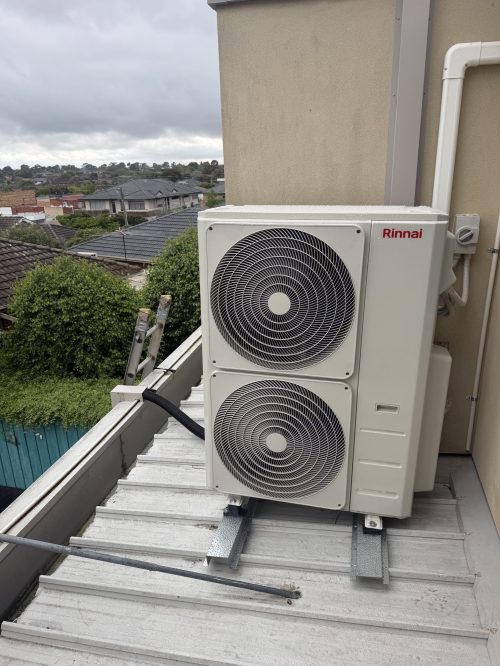
This is a Rinnai multi-split we installed in Cheltenham: a MON6H19B1TA outdoor unit with four indoor heads covering the main lounge and three bedrooms upstairs. It is a common layout, a living area downstairs and bedrooms upstairs, run from one outdoor unit instead of four.
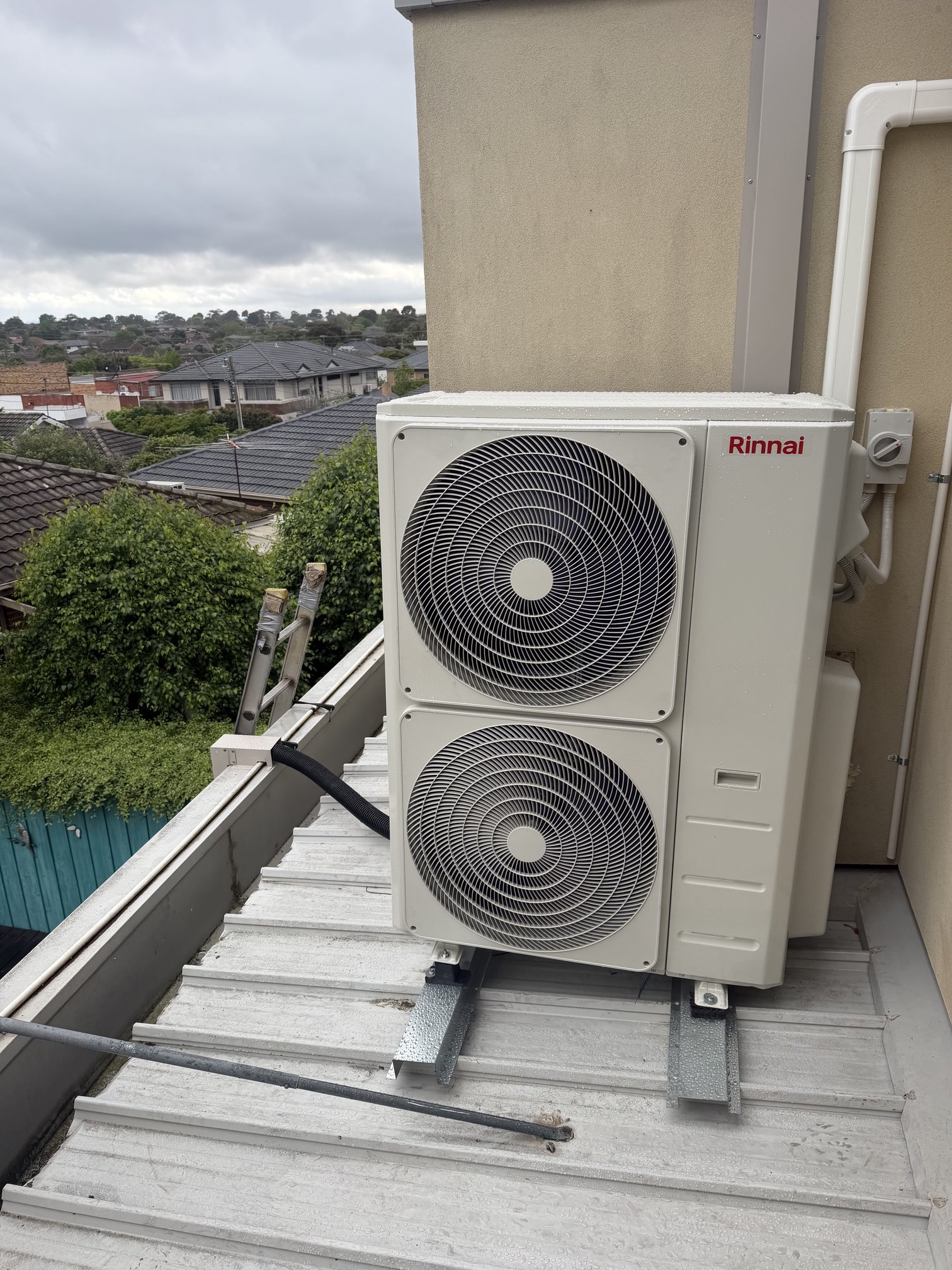
The outdoor unit sits on rails on a metal roof, with its isolator switch on the wall beside it. From there, refrigerant pipes run to a wall-mounted head above the living room’s sliding doors and to a head in each of the three upstairs bedrooms.
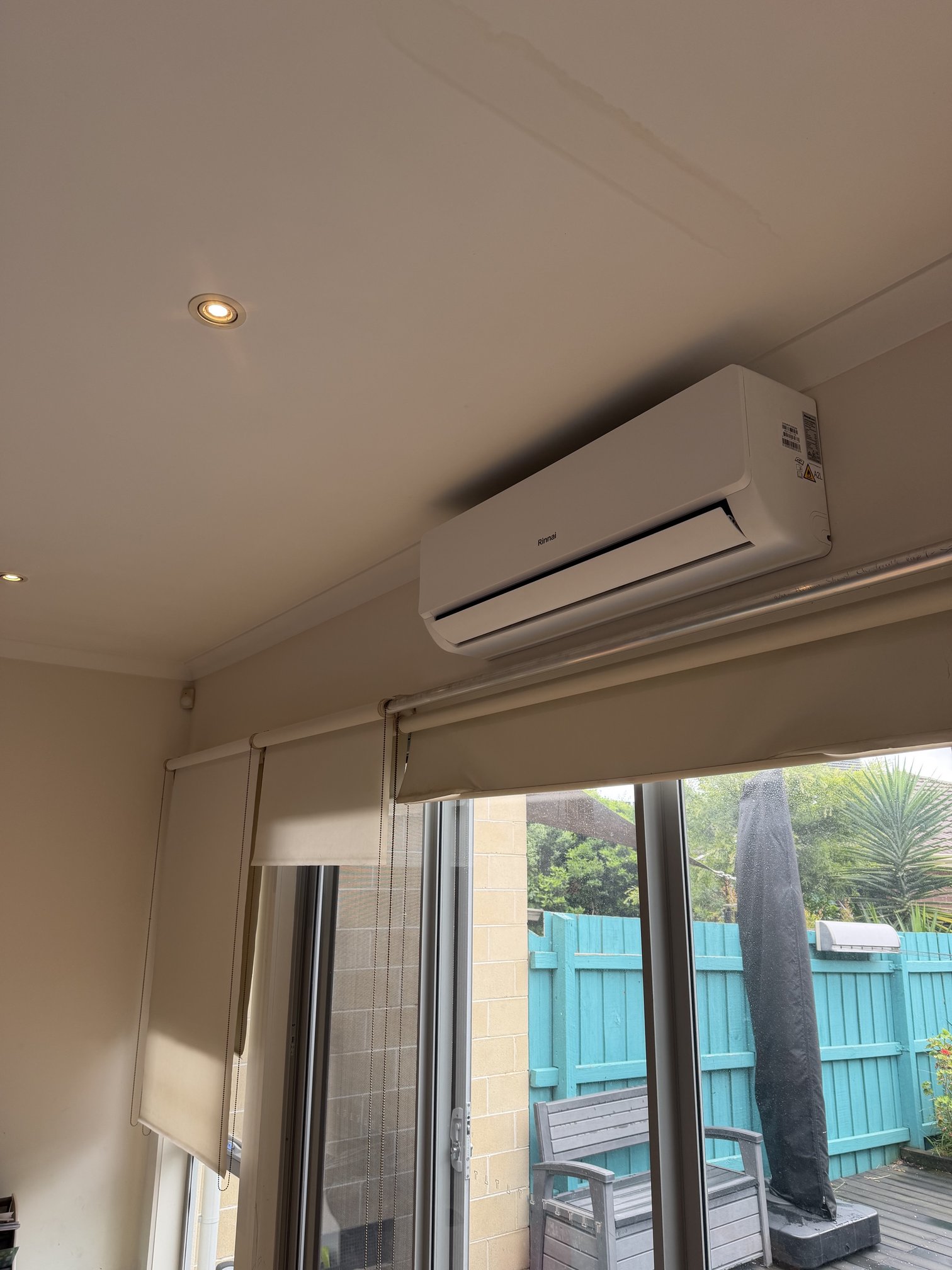
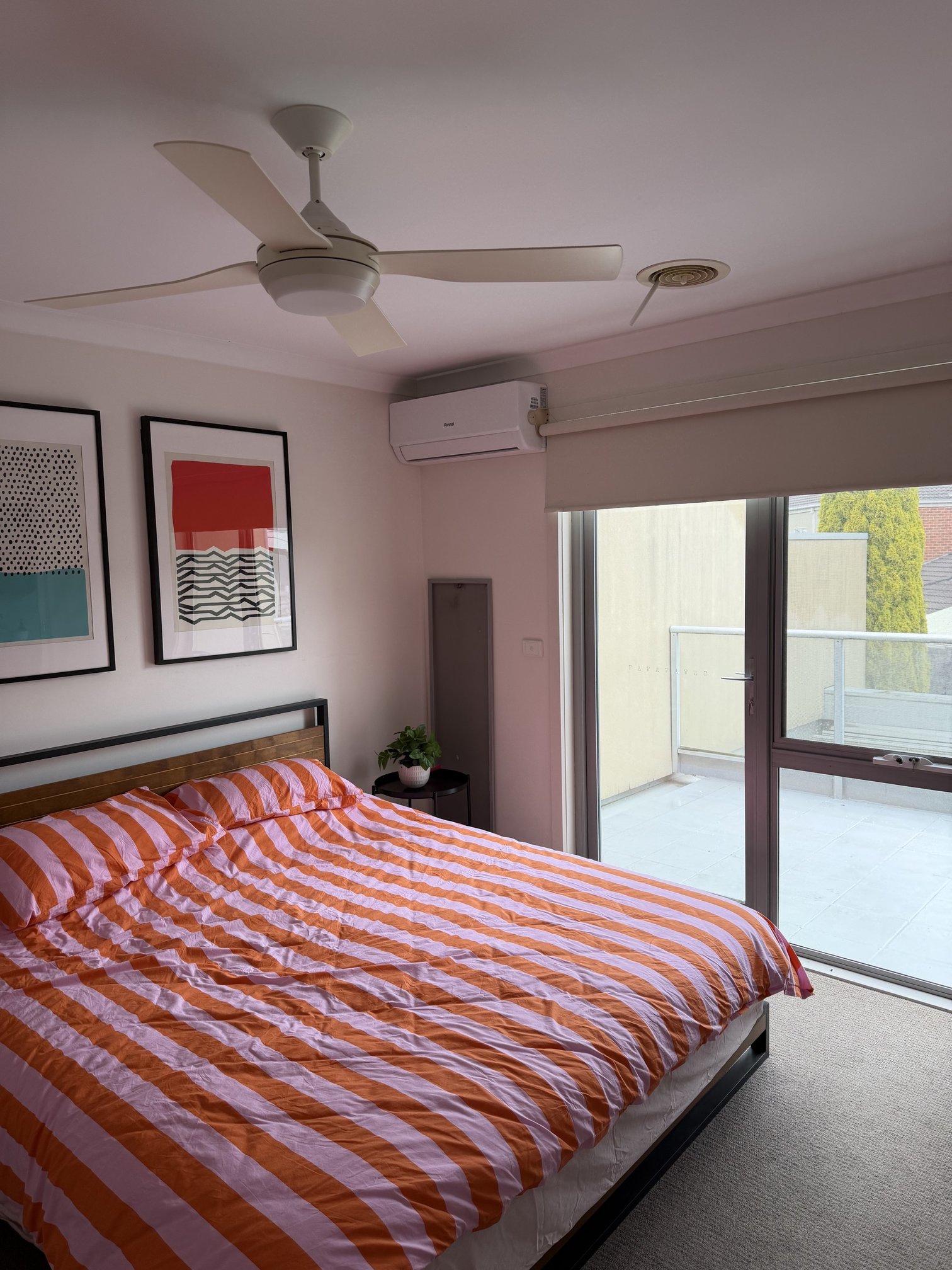
Every multi-split job is priced on the house. Where the outdoor unit can go, how far the pipes run to each room and the home’s layout all change the work, so we look before we quote. More photos from this job are in our gallery.
What a 19 kW Rinnai multi-split costs
A 19 kW Rinnai multi-split with five to six indoor heads is about $12,000 to $13,000 installed with Helcro Electrical, including GST, with no rebate. A system with fewer heads, like the four-head Cheltenham job, is priced on the house. Your written quote follows a $50 site assessment (including GST). Prices for other multi-split brands and sizes are in our split and multi-split installed prices.
If you have seen much lower “after rebate” prices for a Rinnai multi-split online, check the date.
From 30 September 2026, a multi-split with a total rated cooling capacity of 10 kW or more carries a minimum co-payment of $3,000 under the Victorian Energy Upgrades (VEU) program, up from $1,000, so you pay at least that much yourself. For multi-split systems in homes, the heating or cooling capacity used to calculate the VEU incentive is capped at 20 kW in the decommissioning scenarios the VEU rules list; multi-splits up to 39 kW can still be installed.
If your job qualifies, we show the VEU discount on your quote. The rules are on our Victorian Energy Upgrades program page.
Planning a multi-split before summer? Get a Quote or call 1300 201 358. We respond within 2 business hours.
Multi-split or separate split systems?
A multi-split and several single split systems both put a head in each room. The difference is outside.
Why a multi-split:
- One outdoor unit instead of one per room, which saves wall and yard space
- Each room is still controlled on its own
- One outdoor unit to service, though Rinnai stresses regular servicing because the system is more complex
What to weigh up:
- It usually costs more upfront than a single split system for one room
- The design and installation are more involved, and every head is limited by the outdoor unit’s capacity
- If the outdoor unit needs a repair, every room it serves is affected until it is fixed
Rinnai’s own list of benefits and considerations makes the same points, and its FAQ adds one more: a multi-split can be very efficient when only a few rooms are running, but if every room runs constantly, several single split systems may be more efficient.
For a whole house with many rooms, ducted air conditioning is the other option, and our ducted air conditioning cost calculator gives a guide price.
Rinnai air conditioner review: the facts behind the brand
We don’t rank brands, but here are the facts behind Rinnai. Rinnai Australia is a subsidiary of Rinnai Japan Corporation and sources its products both locally and from more than 40 Rinnai manufacturing sites around the world. Its head office is at 88 Mills Road, Braeside, in Melbourne’s South East.
Rinnai’s warranty on its refrigerated air conditioners is 7 years parts and 7 years labour from the day the installation is completed, for homes and light commercial use, when a qualified installer fits it. On top of that, our installation carries Helcro Electrical’s 5-year workmanship warranty, which starts on the certificate date and carries over to a new owner.
Rinnai and Carrier are the multi-split brands we install most often under the VEU program.
Rinnai multi-split questions
Can one room heat while another room cools? No. Rinnai’s multi-split operation manual says heads running at the same time must not be set to conflicting modes, and heating takes priority: once one head is heating, the others can only heat, and switching a head to heat stops heads that are cooling. At any one time, the system is either heating or cooling.
Is the MON6H19B1TA the same as the MON6H18B? They are different models. The MON6H18B was Rinnai’s six-head outdoor unit in 2025: it was on Rinnai’s list of multi-split units covered by its 7-year warranty from 1 April 2025. It is not on Rinnai’s current outdoor-unit list; the current six-head unit is the MON6H19B1TA. For an older unit, Rinnai says its product information covers current products, so check that model’s details with Rinnai.
Does a 19 kW Rinnai multi-split need three-phase power? No. Rinnai lists the MON6H19B1TA as single phase, 220 to 240 V, with a maximum input current of 32 A. We check that your switchboard and circuit can carry it before we quote.
Can I control a Rinnai multi-split by Wi-Fi? Yes. Rinnai’s wall-mounted, compact cassette and floor console heads have Wi-Fi built in, controlled through the NetHome Plus app; Rinnai’s brochure lists Wi-Fi for its slim ducted heads as an optional accessory.
Can I install a multi-split myself? No. In Victoria, installing a multi-head system is refrigerated air-conditioning work under the Plumbing Regulations, so the installer must be licensed or registered with the Building and Plumbing Commission for that work.
It also needs a full refrigerant handling licence from the Australian Refrigeration Council (the restricted split-system licence does not cover multi-head systems), and the electrical work must be done by a licensed electrician. Helcro Electrical holds ARC Refrigerant Trading Authorisation AU50700 and is a registered electrical contractor (REC 35448); our team members are registered with the Building and Plumbing Commission for air conditioning work, and our own team does the whole job.
How long does a Rinnai multi-split last? Rinnai says: “With proper installation and maintenance: 10–15 years is typical.” It adds that regular servicing matters because a multi-split is a more complex system.
Get a quote for a Rinnai multi-split
Tell us how many rooms you want to heat and cool, and we will tell you whether a Rinnai multi-split suits the house. Our own team does the whole job, and the installation carries our 5-year workmanship warranty. Get a Quote or call 1300 201 358. We respond within 2 business hours. Written quotes follow a $50 site assessment (including GST). Helcro Electrical is a registered electrical contractor (REC 35448) and a VEU Accredited Provider (A003039).
How we checked this page
The Rinnai figures on this page come from Rinnai’s Inverter Multi-Split brochure (RA122.07.26), its multi-split combination tables (RA95.09.25), its multi-split operation manual (Issue 1, July 2025), its air conditioning warranty booklet (April 2025) and its product, About and Contact pages.
The licence rules come from the Building and Plumbing Commission and the Australian Refrigeration Council’s Fact Sheet 13. The VEU rules come from the Essential Services Commission and the VEU Specifications (Version 25.0); the room sizes come from the Victorian Government’s reverse cycle air conditioning factsheet. Checked on 31 October 2026.