Last updated: 11 November 2026
A safety switch keeps tripping because it has found a problem that may put someone at risk of an electric shock: a faulty appliance, water getting into an outdoor fitting, or a fault in the wiring or the switch itself. It is doing its job. Reset it once. If it trips again, unplug everything and plug things back in one at a time; if it trips with nothing plugged in, call a licensed electrician.
Helcro Electrical, a registered electrical contractor (REC 35448) based in Cheltenham, finds tripping faults across Melbourne’s South East. If yours needs an electrician, call 1300 201 358; we respond within 2 business hours. This is general information, not legal advice.
On this page
- What to do when your safety switch keeps tripping
- Safety switch or circuit breaker: which one tripped?
- Finding the appliance: unplug, reset, plug back in
- Why a safety switch keeps tripping: the usual causes
- When it’s the wiring, and time to call an electrician
- Older homes and rentals: one safety switch, or none
- Safety switch questions
- How we checked this page
- Get a Quote for a safety switch that keeps tripping
What to do when your safety switch keeps tripping
- Check whether it’s only your home. If the street is dark too, it’s an outage: check United Energy’s outage map (CitiPower’s for parts of Caulfield North). If your street has power back and your home doesn’t, United Energy says there may be damage to your private service and you’ll need a licensed electrician.
- Find the switch that’s down. Your switchboard is often in the meter box outside. Energy Safe Victoria’s advice is: “Locate your electricity box outside your home and check whether the safety switch has tripped. If it has tripped, reset the switch. If the switch won’t reset, call a licensed electrician.”
- Reset it once. To reset a safety switch, lift or twist it back to on, as Energy Safe Victoria describes. When it trips it drops to the off position; some newer switches also show a small coloured flag or window, depending on the brand.
- If it trips again, find the appliance, then the circuit (steps below).
Safety switch on or off?
It should be on. If every safety switch is on and the power is still off, the problem is somewhere else: the main switch, a circuit breaker, an outage, or damage to your private service (step 1).
What not to do
Energy Safe Victoria is blunt: “Don’t try to solve any electrical issues or do repairs yourself. It is unsafe and illegal.” Its “Don’t DIY” page adds: “Electrical work isn’t a DIY job, even for small jobs such as changing power points or light switches.”
So the line is simple. You can reset the switch, switch the circuit breakers off and on, switch off and unplug appliances, and look from a distance for water or damage. Don’t:
- hold the switch up, tape it on, or keep resetting it over and over in the hope it stays on
- take a cover off the switchboard, a power point or a light fitting
- touch anything wet, or a fitting that’s sparking, hot or smells of burning
- tap the switch, swap parts, or move a fridge onto a circuit without a safety switch
A safety switch is the device that protects people from electric shock. Energy Safe Victoria says: “Surge diverters and circuit breakers do not act as safety switches for personal protection against electric shock.” Bypassing it takes that protection away.
Safety switch or circuit breaker: which one tripped?
A safety switch (RCD) is a device on your switchboard that cuts the power when it detects electricity leaking to earth. “The power keeps tripping” can mean two different devices, and the causes depend on which one went off. Energy Safe Victoria says a safety switch always has a test button and ’30ma’ printed on it, is sometimes labelled ‘safety switch’, and turns the power off within 0.03 of a second.
| Safety switch (RCD) | Circuit breaker | |
|---|---|---|
| How to spot it | Test button, “30mA” printed on it | No test button (a combined RCBO has one) |
| What it protects | People, from electric shock | Wiring, from short circuits and overloads |
| What makes it trip | Electricity leaking to earth | Too much current: an overload or a short circuit |
| Where to look first | Appliances, water, wiring | What was running on that circuit |
An overload is what a circuit breaker reacts to. A safety switch on its own reacts to electricity leaking to earth and gives no overload protection; a combined safety switch and circuit breaker (RCBO) does both jobs, so it can trip on either. Energy Safe Victoria says a circuit breaker “provides short-circuit and over-current protection such as when a power point is overloaded”, and the CFA lists “tripping circuit breakers and blowing fuses” as signs of an overloaded circuit.
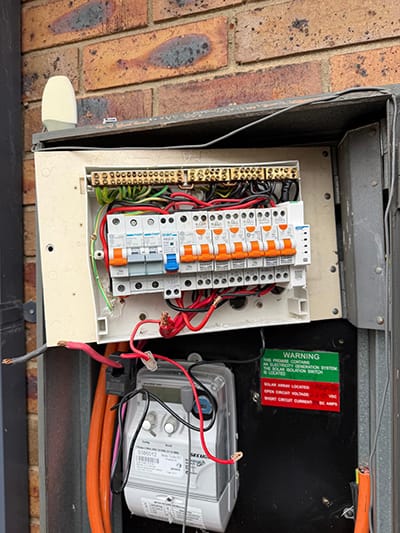
One safety switch can cover several circuits (on new boards, up to three). That is why one fault can take out half the house, and on some boards the lights go off with the power points when the kettle trips it. Labels on older boards don’t always match the rooms, so tell the electrician what went off rather than what the label says.
If your board has ceramic fuses rather than circuit breakers, our ceramic fuse guide covers what to do when one blows.
Finding the appliance: unplug, reset, plug back in
If it trips again as soon as you reset it, find the appliance before you call anyone:
- Switch off and unplug every appliance. Not just off at the wall: pull the plug.
- Reset the safety switch.
- Plug things back in and switch them on one at a time. When it trips, the last thing you plugged in is the likely culprit.
- If it trips with nothing plugged in, find the circuit (next steps), then call a licensed electrician.
That is our advice, and it matches what the South Australian and Tasmanian governments publish.
The appliances people forget to unplug:
- the dishwasher, washing machine and dryer
- the fridge and freezer, including the one in the garage
- an oven, cooktop or rangehood on a plug
- a pool or spa pump
- outdoor and garden lights
- anything on a power board or extension lead
Found it? Leave it unplugged and stop using it. A faulty appliance goes to the maker (check the warranty) or an appliance repairer; a fault in the power point or wiring needs a licensed electrician. If it’s the fridge, it may be the fridge or its power point; an electrician can tell which.
Fridge off while you sort it out? Keep the fridge and freezer shut: Food Standards Australia New Zealand says a closed fridge should keep food cold for around four hours and a freezer shouldn’t defrost for around a day. If in doubt, throw it out.
Still trips with nothing plugged in? Find the circuit
Lights, and appliances wired in rather than plugged in, can’t be unplugged, so the problem may be on one of the circuits. Before you call, you can find which one, using only the switches on the front of the board:
- Switch off all the circuit breakers.
- Reset the safety switch. If it trips with every circuit breaker off, leave it off and call a licensed electrician.
- Switch the circuit breakers back on one at a time. When the safety switch trips, the last circuit breaker you switched on is the likely circuit.
- Leave that circuit breaker off, reset the safety switch, switch the others back on, and call a licensed electrician. Tell them which circuit it was.
Energy Safe Victoria’s steps for turning the power back on after an emergency also say: “Turn on each circuit breaker one at a time.” Skip all of this if the switchboard is wet or damaged, or anything is sparking, hot or smells of burning: leave it off and call.
Why a safety switch keeps tripping: the usual causes
A faulty appliance. Any appliance can develop a fault; the unplug test above finds it.
Water or moisture, often after rain. Look (from a distance) at outdoor power points, outdoor and garden lights, pool or spa equipment and extension leads left outside. Leave that circuit off, don’t touch wet fittings, and call an electrician.
Christmas lights. Lights and leads outside can let water in, like any outdoor fitting. Energy Safe Victoria’s Christmas advice is to use only lights intended for outdoors, never to have “leads lying in water or wet areas”, and to test your safety switch: “if you don’t have safety switch, get one installed or use a portable safety switch.”
Several small leaks adding up. Many modern appliances, such as TVs, computers and chargers, leak a tiny amount of current to earth even when working properly, and on one safety switch those amounts add up; makers such as Hager say a 30mA switch can trip at anything above about 15mA. That is often called nuisance tripping, but it can also point to a real fault, so have an electrician find out which.
Solar, a battery, an EV charger or a heat pump. If the tripping started after new equipment went in, tell the installer or an electrician. For those jobs, see our EV charger installation and solar battery installation pages.
A fault in the wiring or a fitting. Damaged cable, water in a light fitting or a cable chewed by rats or mice are things an electrician checks. None of them are a DIY job.
The switch itself. A safety switch can fail. Only an electrician’s testing can tell whether one that keeps tripping is at fault.
Write down when it trips
Tripping at night, after rain or for no obvious reason? Before you call, note when it happens (the time, the weather, when a particular appliance runs, how long after a reset) and what was running, such as heaters, a pool pump on a timer or an EV on charge. It gives the electrician somewhere to start in the first 30 minutes.
Safety switch still tripping in Melbourne’s South East? Call 1300 201 358 or Get a Quote. We respond within 2 business hours. A service call is $165 including GST for the first 30 minutes on site. If it needs more work, we tell you before anything further starts.
When it’s the wiring, and time to call an electrician
Call a licensed electrician when the safety switch:
- trips with every appliance unplugged
- won’t reset at all
- keeps tripping after you’ve found and unplugged the appliance
- doesn’t turn the power off when you press the test button
Finding why it trips is fault finding, part of our residential electrical work.
Is it dangerous? A trip is the protection working. Holding it on, or living with one that keeps tripping, means that protection isn’t there when you need it. Get it checked.
Urgent signs. If you see sparks, smell burning, feel heat or see water near the switchboard, keep clear. We are open Monday to Friday 8:00am–6:00pm and Saturday 8:00am–1:00pm. We do not advertise round-the-clock callouts. For an urgent electrical fault, call 1300 201 358 and we will confirm availability directly.
Outside those hours, if it’s dangerous, call your distributor’s faults and emergencies line (United Energy 132 099, CitiPower 13 12 80); a fault in your own switchboard or wiring still needs a licensed electrician. If there’s smoke or fire, get out and call 000.
Tingles or shocks. Energy Safe Victoria says: “If you experience tingles or shocks from an electrical appliance or water taps, call your electricity company immediately. A licensed electrician must check the property’s wiring.”
Older homes and rentals: one safety switch, or none
In Victoria, new wiring has needed a safety switch on power circuits since the early 1990s and on lighting circuits since 2001, so a house wired before then may have only one, or none, unless it has been upgraded (when safety switches became compulsory). One safety switch for the whole house means one fault takes out more of it, and a board with none never trips, which isn’t good news; a home switchboard upgrade is typically $1,250 to $2,500 including GST.
Renting? Consumer Affairs Victoria lists a dangerous electrical fault, and the electricity supply not working, as urgent repairs: tell your rental provider (landlord) or agent straight away. Rentals also have their own safety switch rules and 2-yearly electrical safety checks.
What our customers say
…Straight to the point, make the impossible seem straightforward and set our place up to avoid these issues in future…
Mm Mm, Google review
Safety switch questions
How do I test my safety switch, and how often?
Press the test button: the power on that switch should go off, then reset it. After a storm, Energy Safe Victoria says to “press and hold the test button for five seconds.” Energy Safe Victoria asks households to test their safety switches regularly: its videos say every year and its Test. Reset. Protect. page says every three months, so every three months covers both.
Can a safety switch go faulty?
Yes. Energy Safe Victoria’s Test. Reset. Protect. page says: “If lights or appliances don’t lose power then your safety switch may have failed. You should call a licensed electrician immediately to investigate.” Since 1 May 2023, a failed one can’t be replaced with the older Type AC kind, Energy Safe Victoria says; a working older switch doesn’t have to be replaced.
Why does my power keep tripping?
Check which device went off. If it’s a safety switch (test button, “30mA”), something is usually leaking electricity to earth: an appliance, water or the wiring. If it’s a circuit breaker, the circuit is overloaded or has a short. The table above shows how to tell them apart.
How do I reset a safety switch?
Lift or twist it back to on, once. If it trips again, unplug everything and follow the steps above.
How we checked this page
We checked this page against Energy Safe Victoria, Consumer Affairs Victoria, United Energy, the CFA, Food Standards Australia New Zealand, other state governments and safety switch makers’ guides (8 and 10 November 2026).
Get a Quote for a safety switch that keeps tripping
Tell us what tripped, when it happens and what you’ve already unplugged. Get a Quote or call 1300 201 358.