
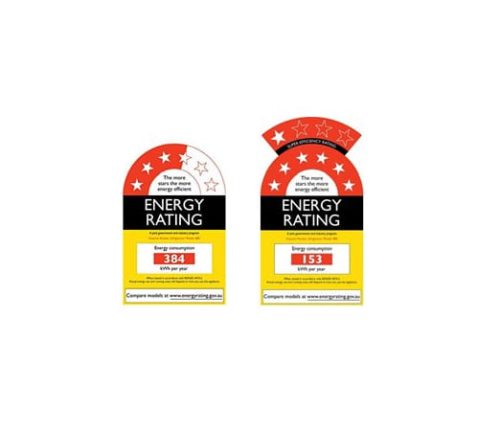
You’ve seen the red and yellow Rainbow Star label. It’s on the side of every air conditioner, washing machine, dishwasher, and refrigerator in the showroom. But when you’re standing in front of a wall of appliances with price tags from $800 to $2,400, it’s easy to default to the cheaper upfront option without doing the maths on what each star rating actually means for your wallet.
Let’s fix that — because in the current energy environment, a 1-star difference on a major appliance can mean hundreds of dollars a year. Over the lifetime of a product, that gap compounds into thousands.
How the star rating system works
Australia’s energy star rating system is run by the federal government and applies to most major household appliances. The more stars, the more efficient the appliance — meaning it uses less electricity to do the same job. The label also shows the estimated annual energy consumption in kilowatt-hours (kWh), which you can multiply by your electricity rate to estimate your annual running cost.
With electricity now averaging around 38.9 cents per kWh nationally — up 7.6% from 2023 — those running cost differences have never mattered more. A 3-star versus a 5-star split system air conditioner in a Melbourne home might mean the difference between $320 and $190 per year in running costs. Across a 10-year product lifespan, that’s $1,300 you either keep or hand to your energy retailer.
The star rating on an appliance reflects how it performs at the time of testing. An older appliance that was 4 stars a decade ago may effectively be performing at 2–3 stars today due to wear, age, and technology improvements in the field.
The appliances where it matters most
Not all appliances are equal when it comes to star rating impact. The ones where efficiency really moves the needle are the ones that run constantly or cycle on and off many times per day: hot water systems, reverse cycle air conditioners, refrigerators, and pool pumps. A heat pump hot water system with a high coefficient of performance (COP) rating will outperform an older electric storage unit by a factor of 3 to 4, meaning it uses a quarter of the electricity for the same amount of hot water. That gap is about to matter even more if your system runs on gas: Victoria’s gas hot water ban comes into effect on 1 March 2027, and there’s a rebate stack that makes switching now the smarter move.
Space conditioning is the other major category. Victoria’s climate — cold winters, increasingly hot summers — means your heating and cooling system works hard. An undersized or inefficient unit doesn’t just cost more to run; it also works harder to achieve the same temperature, which accelerates wear and shortens lifespan.
Global context: why efficiency is more urgent than ever
Across Europe, households have felt the sharp end of energy price volatility since 2022 — with some countries seeing electricity prices rise 50% or more. Australia has been more insulated, but the structural pressures are similar: ageing fossil fuel infrastructure, global commodity markets, and the transition costs of building a renewables-led grid. The households best positioned to weather ongoing price increases are those that have already reduced their dependence on high-consumption appliances.
What Helcro can help with
When you’re upgrading electrical appliances or systems in your Melbourne home, Helcro Electrical can advise on the most efficient products available, what rebates are accessible under the Victorian Energy Upgrades program, and how to maximise your return on investment. We work with leading brands including Rinnai, iStore, and Sungrow — products we know and stand behind.Want to know how much your current appliances are costing you per year? Talk to Helcro Electrical. We can walk you through the numbers and the options.

